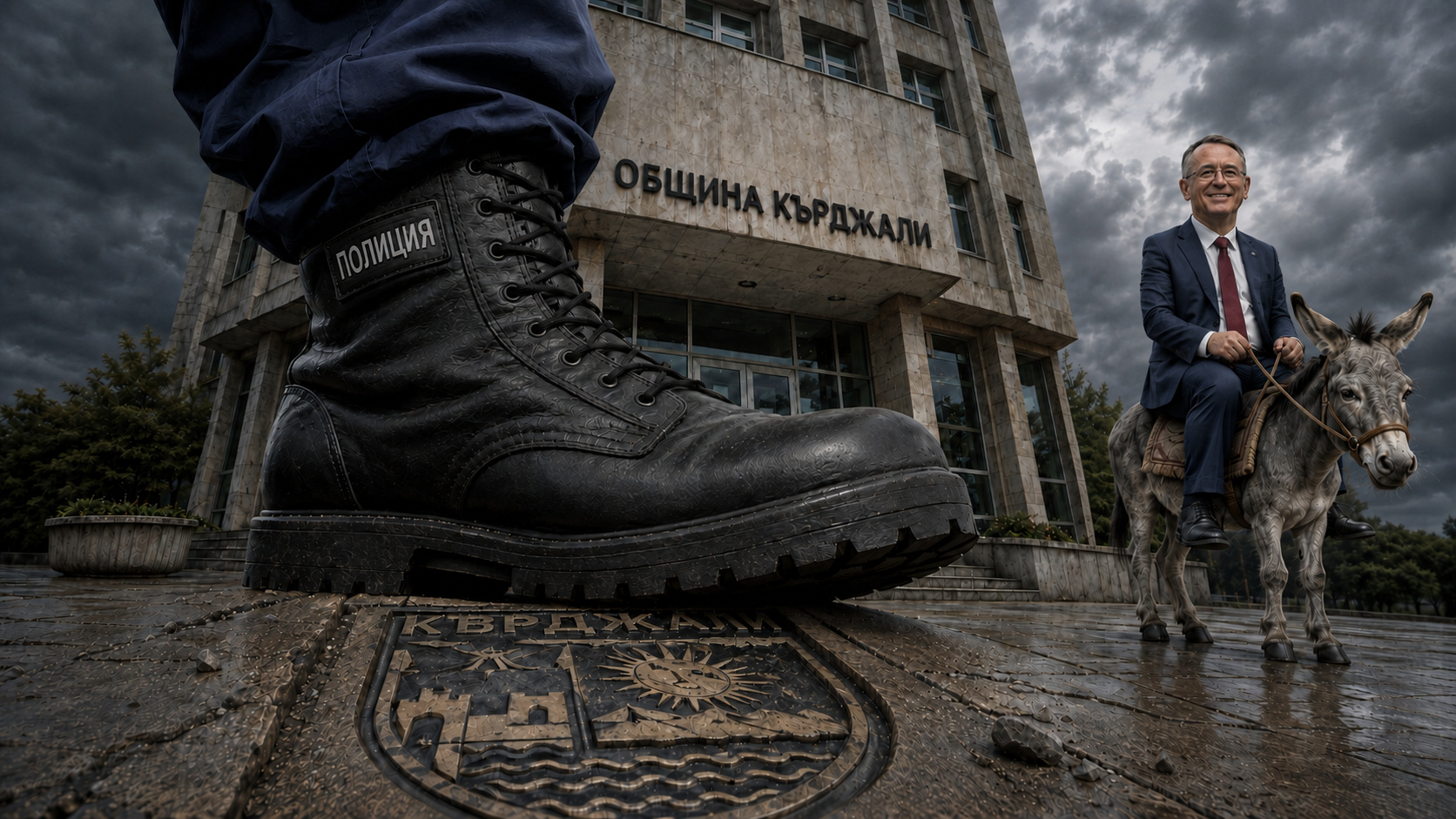
The series of high-profile actions against the two municipalities raises the question of who is generating the reports, why the attacks began precisely now, and whether the remnants of the old local model are behind them
In just a few months, the Municipality of Kardzhali and the Municipality of Chernoochene have found themselves under unprecedented police pressure. Public procurement procedures, repairs, supplies for kindergartens, infrastructure projects, and payments related to spatial planning are being investigated.
No one disputes the right and duty of the police to investigate every well-founded report. The law must be the same for everyone. But when investigations pile up one after another, when the actions are loud and demonstrative, and when no charges against the mayors are subsequently announced, society has the right to ask the question: is an actual crime being sought, or is an impression of guilt being manufactured?
Why Did the Attacks Begin Precisely Now?
Kardzhali and Chernoochene are entering a period of visible change. Infrastructure projects, repairs, improvements, and attempts to free local government from dependencies accumulated over decades have begun.
It was precisely now that the series of reports, investigations, interrogations, and high-profile police actions also began.
This coincidence inevitably raises suspicion that some of the so-called reports may have been submitted by people connected to the old model of governance—its former appointees, dependent officials, and political activists who held positions in local government for a long time.
In the public sphere, the question is increasingly being raised as to whether so-called “sleeper cells” of the old model around Hasan Azis have been activated—people who have formally remained outside power but continue to have contacts, information, and influence in various institutions.
At present, there is no publicly presented evidence that Hasan Azis personally organized the specific reports. Therefore, this cannot be stated as an established fact. But the accumulation of actions, the moment when they began, and the obvious political effect require this possible connection to be investigated as well.
Bayram Was Turned into the Backdrop for a Police Demonstration
The most troubling example was the operation on May 28 at the Municipality of Kardzhali. On the day of the major Muslim holiday Eid al-Adha, police officers entered the office of Mayor Erol Myumyun, handed him a summons for a time that had already passed, and escorted him to the police station.
Myumyun was not formally arrested and was not handcuffed. But the way he was taken out in front of employees, citizens, and cameras inevitably created the impression of an arrest and predetermined guilt.
The Prosecutor’s Office subsequently confirmed that a search and seizure had been carried out at the municipality that same day.
The legitimate question arises: who would think of organizing such a demonstration against the mayor of a city inhabited by thousands of Muslims precisely on Eid al-Adha?
Was there no other day? Could the mayor not have been summoned through the usual procedure? Was the presence of so many police officers and his removal from his office necessary?
The chosen moment may be perceived not only as pressure on one mayor but also as disrespect toward the holiday of an entire religious community. The impression was created that through this operation someone was testing the reaction of the local society: how many people would come out, who would defend the mayor, and how far the pressure could go.
There Are Investigations, but Where Are the Charges?
The operation was followed by investigations into a water facility near the Studen Kladenets Reservoir, food deliveries for kindergartens, the renovation of a community center, and the repair of municipal roads. In Chernoochene, the collection of funds related to an amendment to the General Spatial Development Plan was also investigated.
These are serious matters, and the municipalities must provide all the documentation. But society must also receive information about the results.
How many of the reports have been confirmed?
In how many cases have pre-trial proceedings been initiated?
Have charges been brought against any municipal officials?
How many investigations have ended without a crime being established?
Who bears responsibility if unsubstantiated reports are deliberately used to block the work of local government?
As of August 30, there had been no official announcement of charges against the mayors of Kardzhali and Chernoochene in connection with these investigations. Nevertheless, every new operation is presented loudly, while subsequent developments remain hidden from the public.
Thus, a politically convenient picture is created: the insinuation remains even when evidence of a crime is not presented.
Is Someone Using the Ministry of Interior as an Instrument of Political Pressure?
The most dangerous suspicion is that people from the old local model may be skillfully submitting reports and using their contacts in the Ministry of Interior to harass the new municipal administrations, delay their projects, and destroy public trust in them.
If such coordination exists, it must be investigated with the same determination with which the municipalities are being investigated.
It must be established:
Who is submitting the reports?
Are they connected to the former municipal administration or to the political circle around Hasan Azis?
How many of the reports contain real information, and how many are based on assumptions?
Are there Ministry of Interior employees who provide advance information about police actions?
Who determines the timing and manner in which the high-profile operations are conducted?
Without answers to these questions, the suspicion will remain that the old local power brokers, who have lost part of their influence, are trying to restore it through pressure, reports, and institutional harassment.
Will Dzhebel Be the Next Municipality?
Here another troubling question arises: is it possible that the next municipality to come under police pressure will be Dzhebel?
If, after Kardzhali and Chernoochene, similar high-profile investigations begin there as well, this will not automatically prove the existence of a coordinated political operation. But it will significantly strengthen the suspicion that the actions are not accidental and that a specific political geography is being followed.
People only need to look at the map of Kardzhali Province after the elections. Which municipalities remained outside the dark-green political coloring? Where did the old model lose ground, and where did real change in local government begin?
It was precisely there that the reports, investigations, interrogations, and demonstrative police presence first appeared.
That is why it is necessary to carefully monitor where the next operation will be directed. If, after the elections, the series continues toward the remaining municipalities that are not under the control of the old political model, society will have every reason to ask whether we are witnessing an attempt to restore lost influence through institutional pressure.
Look at the map. See where it all began and which municipalities are still not colored dark green. Then you may be able to guess for yourselves where the investigations might continue after the elections.
If such a prediction comes true, the Ministry of Interior will have to convincingly prove that its actions are based solely on specific facts and evidence, rather than on politically selected reports. Otherwise, the suspicion that the ministry is being used to pressure inconvenient municipalities will become even stronger.
Municipalities Must Not Be Placed Above the Law, but Neither Should They Be Declared Guilty in Advance
The Municipality of Kardzhali and the Municipality of Chernoochene must continue cooperating with the investigating authorities and publish the documents related to the disputed procedures. Transparency is the strongest protection against politically manufactured accusations.
But the Ministry of Interior also owes transparency. It is not enough to enter with police officers, take away a mayor, or announce suspicions involving huge sums. After every operation, society must learn what has actually been proven.
Kardzhali and Chernoochene need development, not continuous institutional harassment. If a crime has been committed, let those responsible be charged and brought before a court. If not, investigations must not be used to humiliate elected mayors and stop the change that has begun.
The old model must not be given the opportunity to return through the back door of the security institutions. And the Ministry of Interior must not become a weapon of local political dependencies.
Society expects truth, evidence, and legality—not spectacle, insinuations, and operations staged so that the verdict is pronounced before the real investigation has even begun.